KOSDAQ Surpasses 1,000 After 20 Years and 7 Months... "Upward Trend to Continue"
Impact of US Stimulus... Small and Mid-Cap Stocks Are Undervalued
KOSPI Ends Session with Slight Gains

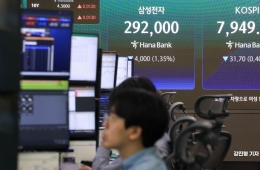
On the 26th, dealers are working in the dealing room of Hana Bank in Euljiro, Seoul, as the KOSDAQ index surpassed the 1000 mark. It is the first time in 20 years and 4 months since September 15, 2000, that the KOSDAQ has stayed above 1000. Photo by Moon Honam munonam@
View original image[Asia Economy Reporter Gong Byung-sun] The KOSDAQ closed above the 1000 mark for the first time in 20 years and 7 months. This breakthrough is attributed to the U.S. economic stimulus package and the expectation that small and mid-cap stocks, which had been undervalued compared to large-cap stocks, will record strong performances in the first quarter of this year.
On the 12th, the KOSDAQ closed at 1000.65, up 1.14% (11.26 points) from the previous trading day. At 3:15 p.m., it recorded 1000.11, surpassing the 1000 mark, and continued its upward trend thereafter. The market capitalization also closed at a record high of 411.1 trillion KRW.
This is the first time the KOSDAQ has closed above 1000 since September 14, 2000 (1020.70). At that time, the dot-com boom pushed the KOSDAQ to as high as 2925.20 in March 2000. However, after the dot-com bubble burst, the KOSDAQ index plummeted about 82% from its peak to 525 by the end of 2000.
The breakthrough above 1000 is seen as a result of the Biden administration's economic stimulus package and the proper revaluation of previously undervalued small and mid-cap stocks. Kim Yong-gu, a researcher at Samsung Securities, explained, “The Biden administration has introduced an infrastructure-focused stimulus package worth $2.25 trillion following last month's $1.9 trillion (approximately 2138 trillion KRW) package, generating overall optimism in the stock market.” He added, “While large-cap stocks have already priced in the stimulus expectations, small and mid-cap stocks remain relatively undervalued. The first-quarter earnings of small and mid-cap stocks included in the KOSDAQ were not bad, and there is still room for growth.”
The rise in the KOSDAQ was led by foreign investors and institutions, who net purchased 36.3 billion KRW and 1.9 billion KRW, respectively. Individual investors net sold 19.5 billion KRW.
Almost all sectors rose. The 'Other Manufacturing' sector saw the largest increase at 3.65%, followed by Paper & Wood (3.47%), General Electric & Electronics (2.68%), Pharmaceuticals (2.66%), and Finance (2.20%). On the other hand, Broadcasting Services (-1.01%), Telecommunications & Broadcasting Services (-0.81%), Publishing & Media Replication (-0.81%), Computer Services (-0.58%), and Transportation Equipment & Parts (-0.54%) declined.
Most of the top 10 market capitalization stocks rose. EcoPro BM led with an 8.54% increase, likely due to the resolution of uncertainties after its major client SK Innovation settled a lawsuit with LG Energy Solution. This was followed by Seegene (4.31%), SK Materials (3.78%), Pearl Abyss (2.91%), Celltrion Pharm (1.60%), Celltrion Healthcare (1.48%), and Kakao Games (1.29%). HL Biopharma (-1.68%), Alteogen (-1.01%), and Studio Dragon (-0.47%) declined.
The KOSPI closed at 3135.59, up 0.12% (3.71 points) from the previous day. It briefly fell to 3129.02 at 2:43 p.m. before recovering.
Individual investors drove the KOSPI's slight gains, net buying 691.3 billion KRW. In contrast, institutions and foreign investors net sold 389.6 billion KRW and 327.8 billion KRW, respectively.
Many sectors rose, with Non-metallic Minerals leading at 2.56%, followed by Textiles & Apparel (1.86%), Chemicals (1.54%), Telecommunications (1.28%), and Pharmaceuticals (1.24%). Meanwhile, Medical Precision (-2.81%), Electric & Electronics (-0.76%), Construction (-0.74%), Securities (-0.66%), and Machinery (-0.53%) declined.
Hot Picks Today
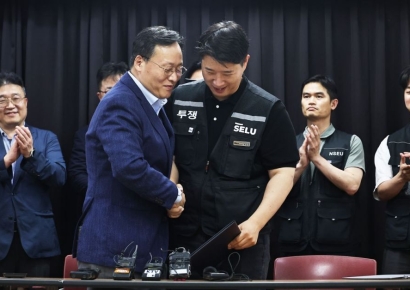 Up to 600 Million Won for Semiconductors, 160 Million Won Bonus for Loss-Making Non-Memory… Samsung Electronics Labor and Management Reach Tentative Deal on Unprecedented Performance Compensation (Comprehensive)
- "Could I Also Receive 370 Billion Won?"... No Limit on 'Stock Manipulation Whistleblower Rewards' Starting the 26th
- "From a 70 Million Won Loss to a 350 Million Won Profit with Samsung and SK hynix"... 'Stock Jackpot' Grandfather Gains Attention
- [Current State of K-Finance for Foreign Nationals]①From Niche to Core... Banks Go All-In on First-Mover Competition
- "Who Is Visiting Japan These Days?" The Once-Crowded Tourist Spots Empty Out... What's Happening?
The top 10 market capitalization stocks showed mixed results. Samsung Biologics led the gains with a 1.56% increase, followed by LG Chem (0.62%), NAVER (0.52%), and Celltrion (0.32%). SK Hynix fell the most at -1.79%, followed by Samsung SDI (-1.21%), Hyundai Motor (-1.09%), Samsung Electronics (-0.48%), and Kia (-0.35%). Kakao remained flat.
© The Asia Business Daily(www.asiae.co.kr). All rights reserved.