National Assembly Industry Committee Submits Government Proposal on Coupang-Originated Venture 'Differential Voting Rights'
Coupang's 'Korean Stock Market Passing' Spurs Momentum
Discussion Expected at Next Month's Committee Meeting

[Asia Economy Reporter Koo Chae-eun] The National Assembly's Industry, Trade, Energy, Small and Medium Venture Business Committee held a plenary session on the 23rd and submitted the "Partial Amendment to the Special Measures Act on Fostering Venture Businesses (Government Bill)" centered on the introduction of differential voting rights.
If the bill passes the review at the bill subcommittee (Small and Medium Venture Business Subcommittee) scheduled for next month, it is expected to be processed within the March extraordinary session after going through the Legislation and Judiciary Committee and the plenary session. (Reported on pages 1 and 6, February 18)
Differential voting rights is a system designed to allow founders or managers to operate companies without worrying about losing management rights. Recently, there have been criticisms that Coupang chose to list on the U.S. stock market because Korea lacks differential voting rights, which has accelerated the legislative process.
On this day, Lee Hak-young, chairman of the Industry, Trade, Energy, Small and Medium Venture Business Committee, opened the plenary session and announced that agenda items 1 through 138 would be submitted collectively. The "Venture Business Fostering Amendment Bill (Government Bill)" containing the introduction of differential voting rights was submitted as item 80. The main content of the government bill allows unlisted venture companies to have voting rights of two or more per share, up to a maximum of ten. Under the current Commercial Act, the principle of shareholder equality grants only one voting right per share, but this bill's core is to recognize an exception only for unlisted venture companies.
Minister Kwon Chil-seung of the Ministry of SMEs and Startups, the relevant ministry, responded to Justice Party lawmaker Ryu Ho-jeong's concern that "there could be negative effects of differential voting rights," by stating, "In Korea, there has been no system related to differential voting rights," and added, "The government bill allows differential voting rights only for founders with the consent of three-quarters, effectively enabling them to be the complete owners of the company," explaining that side effects would be minimal.
Hot Picks Today
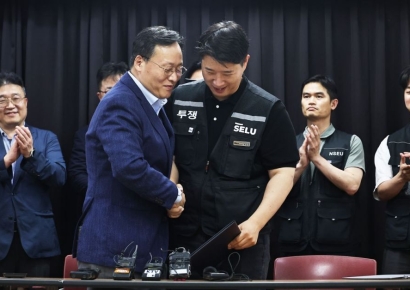 Up to 600 Million Won for Semiconductors, 160 Million Won Bonus for Loss-Making Non-Memory… Samsung Electronics Labor and Management Reach Tentative Deal on Unprecedented Performance Compensation (Comprehensive)
- "Could I Also Receive 370 Billion Won?"... No Limit on 'Stock Manipulation Whistleblower Rewards' Starting the 26th
- "From a 70 Million Won Loss to a 350 Million Won Profit with Samsung and SK hynix"... 'Stock Jackpot' Grandfather Gains Attention
- Opening a Bank Account in Korea Is Too Difficult..."It Costs 150,000 Won Just to Open a Child's Account or Check Card" [Foreigner K-Finance Status]②
- "Who Is Visiting Japan These Days?" The Once-Crowded Tourist Spots Empty Out... What's Happening?
Minister Kwon said, "Major resolutions cannot be executed with multiple voting rights, including issues related to capital reduction, board authority, salaries, and dividend distribution," and added, "Compared to other foreign legal systems, the authority to actually use multiple voting rights will be limited." He further stated, "Since venture companies are seen as a key sector that will open the horizon of competition leading Korea's industry in the future, the bill provides grounds to allow them to receive large-scale investments more freely and conduct business activities."
© The Asia Business Daily(www.asiae.co.kr). All rights reserved.