Seoul City Selected as UN-Certified 'City Resilient to Climate Change and Disasters'
Excellent in Citizen-Led Safety Issue Resolution and Smart City Implementation Based on 4th Industrial Revolution Technologies

[Asia Economy Reporter Jo In-kyung] The Seoul Metropolitan Government announced on the 22nd that it has been certified as a 'Disaster Risk Reduction Role Model City' by the United Nations Office for Disaster Risk Reduction (UNDRR), a UN agency.
This means Seoul has been selected as a city that serves as a model for other cities by achieving innovative and sustainable results in disaster risk reduction and urban resilience.
The UNDRR campaign "Making Cities Resilient (MCR)" launched in 2010 requires cities to demonstrate excellent performance in at least three of the ten essential implementation areas. The ten areas are: ▲organization for disaster resilience ▲strengthening financial capacity for recovery ▲preservation of natural buffers ▲understanding and enhancing social capacity for resilience ▲ensuring effective disaster preparedness and response ▲analysis, understanding, and utilization of current and future risk scenarios ▲pursuit of resilient urban development and design ▲strengthening institutional capacity for resilience ▲enhancing resilience of social infrastructure ▲rapid recovery and better reconstruction.
This campaign, initiated by UNDRR to encourage cities to become disaster-resilient and sustainable on their own, currently has 4,360 cities from 228 countries participating. In South Korea, a total of 175 local governments, including 15 metropolitan governments such as Seoul and 160 basic local governments, have joined.
Seoul joined the MCR campaign in 2013, analyzed its overall disaster response since 2017, identified best practices from 2019, and submitted all ten performance areas to UNDRR in February this year. After evaluation, Seoul received the final selection notification on the 17th.
Seoul received high marks particularly for implementing a smart city based on data through core Fourth Industrial Revolution technologies such as the Internet of Things (IoT) and Artificial Intelligence (AI), efforts to comply with the Paris Climate Agreement including the spread of solar power and eco-friendly vehicles, and citizen-led safety problem-solving initiatives. Seoul’s disaster response policies will be introduced in future MCR campaign reports and promotional materials.
Meanwhile, UNDRR recently launched a new MCR 2030 campaign (2021?2030) by adding a 'public health' indicator to the urban resilience diagnostic tool Scorecard, in response to the emerging infectious disease issues caused by COVID-19.
Hot Picks Today
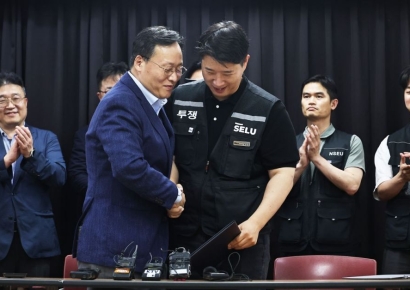 Up to 600 Million Won for Semiconductors, 160 Million Won Bonus for Loss-Making Non-Memory… Samsung Electronics Labor and Management Reach Tentative Deal on Unprecedented Performance Compensation (Comprehensive)
- "Could I Also Receive 370 Billion Won?"... No Limit on 'Stock Manipulation Whistleblower Rewards' Starting the 26th
- "From a 70 Million Won Loss to a 350 Million Won Profit with Samsung and SK hynix"... 'Stock Jackpot' Grandfather Gains Attention
- U.S. Stocks Up 1% on War Negotiation Hopes... Will Korea Recover Recent Losses? [Good Morning Market]
- "Who Is Visiting Japan These Days?" The Once-Crowded Tourist Spots Empty Out... What's Happening?
Han Je-hyun, Director General of Safety at Seoul Metropolitan Government, said, "We will continue efforts to protect citizens’ safety and property from various disasters, present best practices, and strengthen solidarity and cooperation among global cities for climate change and disaster-resilient, sustainable cities."
© The Asia Business Daily(www.asiae.co.kr). All rights reserved.







