BOK "Not a V-Shaped Recovery"... Hong Nam-ki "Entering Economic Recovery Track" (Summary)
Economy Revived by Exports, Q3 Growth Rate 1.9%
Escaping Negative Growth for 2 Consecutive Quarters
Exports Centered on Cars and Semiconductors Up 15.6%...Private Consumption Shrinks Amid COVID Resurgence

Park Yang-su, Director of the Economic Statistics Bureau at the Bank of Korea, is answering reporters' questions using a graph at the briefing on the preliminary real GDP for the 3rd quarter of 2020, held on the morning of the 27th at the Bank of Korea in Jung-gu, Seoul.
View original image[Asia Economy Reporters Eunbyeol Kim and Sehee Jang] Overcoming two consecutive quarters of negative growth due to the shock of the novel coronavirus infection (COVID-19), the South Korean economy rebounded by nearly 2% in the third quarter. However, the third-quarter economic growth rate was largely influenced by the base effect from the easing of lockdown measures in the U.S. and Europe, and it is considered difficult to view this as a 'V-shaped recovery.'
On the 27th, the Bank of Korea announced that the real gross domestic product (GDP, preliminary figure) for the third quarter was 456.8635 trillion won, an increase of 1.93% compared to the previous quarter. This is the highest quarterly GDP growth rate since the first quarter of this year (2.0%). However, compared to a year ago, it still shows a contraction of -1.3%, continuing the negative growth trend.
The rapid recovery in exports due to the lifting of lockdown measures in the U.S. and Europe was a key factor driving the growth rate up quickly. Exports, which had fallen to -16.1% in the second quarter, marking the worst shock since 1970, increased by 15.6% in the third quarter. In particular, exports, the backbone of the Korean economy, increased centered on automobiles and semiconductors. Imports also rose by 4.9%, mainly in crude oil and chemical products, turning positive from -6.7% in the second quarter.
Private consumption, which grew by 1.5% in the first quarter, turned negative again (-0.1%). This was due to strengthened social distancing measures following the resurgence of COVID-19 starting in mid-August. The record-breaking monsoon rains and heavy rainfall this summer also appear to have reduced private consumption. Government consumption increased by 0.1%, mainly due to health insurance benefit payments. Construction investment decreased by 7.8%, mainly in civil engineering, due to the impact of the monsoon and a reduction in the government's social overhead capital (SOC) budget. The decline in construction investment was the largest on a quarterly basis since the first quarter of 1998 (-9.6%). The government significantly reduced the SOC budget while spending money on transfer payments such as emergency disaster relief funds and consumption coupons to respond to the COVID-19 crisis. The encouraging part is that facility investment increased significantly. Facility investment rose by 6.7% as machinery such as semiconductors and displays, as well as transportation equipment, all increased.
Meanwhile, real gross domestic income (GDI) in the third quarter increased by 2.5% due to improved terms of trade. Real GDI exceeded the real GDP growth rate. An increase in GDI can improve corporate profitability, enabling consumption and investment, and is expected to have a positive impact on employment. The government also evaluated that the economy has entered a recovery trajectory toward normalization. However, the Bank of Korea stated that it is difficult to view this as a 'V-shaped recovery.'

Base Effect of Exports Was Large, but... "Not a V-Shaped Recovery"
Exports in the third quarter rebounded by 15.6% compared to the previous quarter, turning sharply positive. The second quarter's growth rate plunged to -3.2%, largely due to exports declining by -16.1%, but the recovery in exports led to a much stronger-than-expected rebound in the growth rate. Among exports, goods exports rebounded by as much as 18.2% compared to the previous quarter. The contribution of net exports fell to -4.1 percentage points in the second quarter but jumped to 3.7 percentage points in the third quarter.
The government expects exports to improve in the fourth quarter as terms of trade ease. Although the resurgence of COVID-19 is severe in the U.S. and Europe, it is considered unlikely that lockdown measures like those earlier this year will be implemented again. However, it is difficult to expect the pace of improvement to accelerate.
Professor Inho Lee of Seoul National University’s Department of Economics said, "Except for China, there is nowhere we can properly trade with, and the U.S. and Europe are unable to fully recover," adding, "It seems difficult for South Korea to find growth momentum overseas for the time being." The continuation of anti-China trends and the likelihood of ongoing trade wars after the U.S. presidential election are also unwelcome news for exports.
The Bank of Korea acknowledged that the increase in the third-quarter growth rate was larger than the forecast (1.3~1.4%) but also stated that it is still far from the expected V-shaped recovery. According to estimates by the Bank of Korea’s Economic Statistics Department, which set the seasonally adjusted GDP for the first quarter of last year as 1, the GDP for the third quarter of this year is still around 1.001, similar to the first quarter of last year. It falls far short of the pre-COVID-19 GDP growth trend line. Park Yang-su, head of the Bank of Korea’s Economic Statistics Department, explained, "A V-shaped recovery should be judged by whether it rises sharply compared to the growth trend line," adding, "It is still hesitant to call this a V-shaped recovery." He further noted, "While goods exports have recovered to last year's levels, service exports still record negative figures," and "Looking at GDP by economic activity, manufacturing sharply declined in the second quarter but has recovered significantly, whereas services are recovering very slowly in comparison."
Regrettable COVID-19 Resurgence and Monsoon... Without Resurgence, Mid-2% Growth Was Possible
Private consumption, which rebounded by 1.5% in the second quarter due to the government's emergency disaster relief funds and individual consumption tax cuts, shrank again due to the COVID-19 resurgence. Private consumption in the third quarter fell by 0.1% compared to the previous quarter, and as private consumption contracted, the contribution of total domestic demand to growth (-1.7 percentage points) turned sharply negative compared to 0.9 percentage points in the second quarter.
The Bank of Korea analyzed that social distancing measures due to the COVID-19 resurgence lowered the growth rate by about 0.4 to 0.5 percentage points. It judged that if the consumption recovery seen in the second quarter had continued without the COVID-19 resurgence, growth in the third quarter could have reached the mid-2% range. The monsoon and record-breaking heavy rains are also estimated to have reduced the growth rate by about 0.1 to 0.2 percentage points.
Although there is an impact from the COVID-19 resurgence, the Bank of Korea’s annual growth forecast (-1.3%) is expected to be comfortably achievable. Based on the third-quarter growth rate, if the fourth quarter shows growth of 0.0 to 0.4% compared to the previous quarter, an annual growth rate of -1.3% is possible. Park said, "There is hope that the annual growth rate could be revised upward from the previous forecast, but the resurgence of COVID-19 in the U.S. and Europe remains a risk factor."
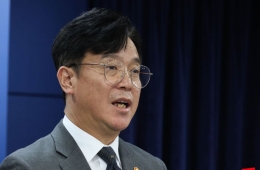
![Hong Nam-ki, Deputy Prime Minister and Minister of Economy and Finance, is presiding over the 4th Innovation Growth Strategy Meeting held at the Government Seoul Office Building on the morning of the 27th. [Image source=Yonhap News]](http://www.asiae.co.kr/news/img_view.htm?img=2020102711265066962_1603765609.jpg)
Hong Nam-ki, Deputy Prime Minister and Minister of Economy and Finance, is presiding over the 4th Innovation Growth Strategy Meeting held at the Government Seoul Office Building on the morning of the 27th. [Image source=Yonhap News]
View original imageHong Nam-ki: "Entered Recovery Trajectory... At 94.7% of Pre-Crisis Level"
The government was highly encouraged as the third-quarter growth rate came out higher than expected. Deputy Prime Minister and Minister of Economy and Finance Hong Nam-ki said at the 4th Innovation Growth Strategy Meeting that "Growth rebounded significantly, centered on exports, entering a recovery trajectory toward economic normalization," adding, "It raises expectations for overcoming the crisis." On Facebook the same day, Deputy Prime Minister Hong wrote, "If we set the GDP of the fourth quarter of 2019, just before the crisis, as 100, we are currently at 97.4%. Compared to major advanced countries such as the U.S. at 95.9% and the U.K. at 90.9%, this is estimated to be the best level."
The government plans to actively promote domestic demand revitalization packages such as resuming the distribution of consumption coupons, Korea Sale Festa, and Christmas market events to boost domestic demand recovery. It also plans to strengthen online export support so that export companies can actively utilize large overseas shopping events in October and November. However, there are concerns that if the government hastily pursues consumption stimulation policies to boost growth, it could again loosen quarantine measures as it did in August. Consumption stimulation policies are a double-edged sword: they are tools to raise economic growth rates but can also shrink private consumption again if the resurgence worsens.
Hot Picks Today
 "Stocks Are Not Taxed, but Annual Crypto Gains Over 2.5 Million Won to Be Taxed Next Year... Investors Push Back"
- "Don't Throw Away Coffee Grounds" Transformed into 'High-Grade Fuel' in Just 90 Seconds [Reading Science]
- Kakao Union: "All Five Unions, Including Headquarters, Approve Strike Vote"
- "Groups of 5 or More Now Restricted"... Unrelenting Running Craze Leaves Citizens and Police Exhausted
- "Even With a 90 Million Won Salary and Bonuses, It Doesn’t Feel Like Much"... A Latecomer Rookie Who Beat 70 to 1 Odds [Scientists Are Disappearing] ③
© The Asia Business Daily(www.asiae.co.kr). All rights reserved.