Growing Controversy Over New Deal Fund... Government Sweats Over Daily Explanations

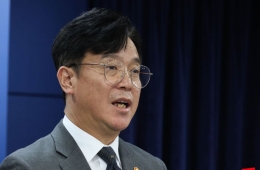
Hong Nam-ki, Deputy Prime Minister and Minister of Economy and Finance, and Eun Sung-soo, Chairman of the Financial Services Commission, are announcing the 'Korean New Deal Financial Support Plan' at the government Seoul office briefing room on the 3rd. Photo by Moon Ho-nam munonam@
View original image[Asia Economy Reporter Jo Gang-wook] As controversy grows over the government-driven 'New Deal Fund,' the government is struggling daily to provide explanations.
Less than a day after stating on the 3rd that the New Deal Fund would initially absorb losses up to 35%, assuring the public that they could invest with confidence, the government corrected this figure to 10%. This has sparked debates ranging from accusations of a 'populist fund' that covers investment losses with taxpayers' money to criticisms of a 'government-controlled fund' that coerces the financial sector into participation.
There are even concerns that the New Deal Fund might follow in the footsteps of the 'Green Fund' and 'Unification Fund' initiated by the previous Lee Myung-bak and Park Geun-hye administrations.
On the 5th, the Financial Services Commission issued a press release addressing questions about the New Deal Fund in a Q&A format.

Below is the full Q&A on the New Deal Fund released by the Financial Services Commission.
- Why was a fund mobilizing taxpayers' money created? Why was this the first fund to cover losses with public funds?
▲ The government has so far focused on responding to the COVID-19 crisis, but after the pandemic ends, the formation of a new economic order is inevitable. To avoid falling behind in global competition in the post-COVID era, it is essential to prepare for changes in the future economic order.
Accordingly, the government has identified 'digital' and 'green' as the core keywords for future response and decided to invest 160 trillion won in fiscal spending to promote the 'Korean New Deal.'
To successfully implement the 'Korean New Deal,' the plan is to create a 20 trillion won policy fund by utilizing excess liquidity in the market.
However, to smoothly attract private capital, safeguards are necessary, so a certain level of fiscal investment is required. In this case, the fiscal input (3 trillion won) is expected to generate effects exceeding this amount (attracting 17 trillion won in private capital).
For reference, the fiscal sector taking on subordinated risk is a common policy measure to attract private capital, with many precedents such as the Smart Korea Fund and Corporate Restructuring Innovation Fund.
The Smart Korea Fund, which focuses on startups and venture companies (risk burden ratio 10%), and the Corporate Restructuring Innovation Fund, which invests in companies undergoing restructuring (7.5%), both involve the public sector bearing some losses first along with matching investments.
- Did the government coerce the financial sector to create a government-controlled fund and force investments in New Deal sectors?
▲ With increasing liquidity and a prolonged low-interest-rate environment, financial companies have limited attractive investment options.
Many financial companies perceive New Deal sectors such as digital and green not as 'passive support targets' but as 'new opportunities.'
From the financial companies' perspective, they can gain investment opportunities by leveraging fiscal risk-sharing and also accumulate experience in project analysis and investment.
For reference, the investment plans in New Deal sectors announced by financial companies are based on their own management strategies.
- Past government-led government-controlled funds all failed; won't this one fail too?
▲ Past funds like the Green Fund and Unification Fund lacked substantial projects. In contrast, the Korean New Deal has differentiated strengths in the following aspects.
Digital and green are globally spotlighted new industries, with related budget projects selected, providing a considerable level of project concreteness. Unlike past funds, the fiscal sector also takes on subordinated risk, and substantial experience in managing policy funds has been accumulated over recent years.
- Will the New Deal Fund disappear when this government's term ends?
▲ As mentioned earlier, the core of the rapidly changing global economic order is the digital and green economy. This global trend is unlikely to change easily even if the government changes.
Even after this government's term ends, the importance and growth potential of New Deal sectors are expected to continue, and the financial sector is also anticipated to maintain investments in these sectors based on their own management strategies under such trends.
- The scope of the New Deal is unclear, and there are virtually no investable projects yet; isn't it still lacking concreteness?
▲ A total of 160 trillion won in fiscal spending is planned for the Korean New Deal over the next five years, with 21.3 trillion won included in the 2021 budget announced on the 1st. Specifically, this includes strengthening the DNA ecosystem such as building a data dam and 5G·AI-based intelligent government (5.4 trillion won), expanding low-carbon and distributed energy such as intelligent smart grids and renewable energy support (4.3 trillion won), among others.
Since New Deal project details are presented through the budget, asset management companies are expected to actively propose related investment projects. Additionally, investments will also be made through blind funds that raise capital without pre-selecting investment targets.
- The New Deal Fund lacks investment appeal. Can it absorb market liquidity on its own?
▲ Due to the nature of New Deal sectors, there is significant uncertainty and long investment periods, making it difficult for private capital to actively invest. Therefore, fiscal support lowers the risk-sharing of policy funds, and tax incentives encourage infrastructure fund investments.
Furthermore, mechanisms will be established through policy financial institutions to allow investors to recover their investments (exit) at appropriate times. For example, plans to create a secondary market exist.
Despite abundant market liquidity, the low-interest-rate environment continues (as of July this year, 1-year fixed deposits at 0.94%, and as of September 3, 3-year government bonds at 0.92% / 10-year bonds at 1.52%), resulting in very low returns on financial products. If slightly higher returns are offered while diversifying risks, it is expected to sufficiently attract private capital.
- Will New Deal Fund investors suffer excessive losses like some recently problematic private equity funds?
▲ Policy funds, infrastructure funds, and private New Deal funds that ordinary citizens can participate in all involve investments under their own responsibility, and there is a possibility of losses depending on the investment process.
The policy New Deal Fund (worth 20 trillion won) consists of fiscal funds (3 trillion won), policy financial institutions (4 trillion won), and private financial companies (13 trillion won). Most private financial companies are banks, insurance companies, and pension funds, and public participation is expected to be up to about 1 trillion won.
However, policy funds involve fiscal subordinated risk, and infrastructure funds include construction companies and investment banks as equity investors in related projects, making their risk-sharing mechanisms different from private equity funds that have no such safeguards.
Meanwhile, private New Deal funds investing in stocks or ETFs of New Deal-related companies are typical public offering funds, exposing investors to stock price decline risks (high return, high risk).
Hot Picks Today
 "Stocks Are Not Taxed, but Annual Crypto Gains Over 2.5 Million Won to Be Taxed Next Year... Investors Push Back"
- "Don't Throw Away Coffee Grounds" Transformed into 'High-Grade Fuel' in Just 90 Seconds [Reading Science]
- Signed Without Viewing for 1.6 Billion Won... Jamsil and Seongbuk Jeonse Prices Jump 200 Million Won in a Month [Real Estate AtoZ]
- "Groups of 5 or More Now Restricted"... Unrelenting Running Craze Leaves Citizens and Police Exhausted
- "Even With a 90 Million Won Salary and Bonuses, It Doesn’t Feel Like Much"... A Latecomer Rookie Who Beat 70 to 1 Odds [Scientists Are Disappearing] ③
Therefore, to prevent situations like those recently seen in some problematic private equity funds, New Deal funds will thoroughly explain fund structures and investment precautions to investors and encourage informed investment decisions.
© The Asia Business Daily(www.asiae.co.kr). All rights reserved.