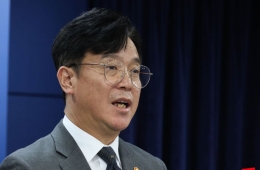
Unified Party's Kang Ki-yoon Submits 'Changwon National University Medical School Establishment Special Act' to the National Assembly
Changwon National University College of Medicine Students Exempted from Admission and Tuition Fees After Obtaining Medical Licenses

[Asia Economy Yeongnam Reporting Headquarters Reporter Hwang Choi Hyun-joo] Kang Ki-yoon, a member of the Future United Party in the National Assembly (Seongsan, Changwon), submitted the "Special Act on the Establishment of the Medical School at Changwon National University" to the National Assembly on the 3rd.
According to Representative Kang, in the case of Gyeongnam Province, the "number of doctors per 1,000 people" is 2.4, which is lower than the national average of 2.8, and among the 16 metropolitan cities and provinces nationwide, the "quota of medical school students" relative to the population ranks 14th from the bottom, indicating that the "medical personnel training infrastructure" is weak.
Moreover, Changwon is a leading advanced machinery industry complex in Korea, with many industrial workers residing there, and a national industrial complex has been established, making it a region with very high demand for industrial health medical services.
Representative Kang proposed the "Special Act on the Establishment of the Medical School at Changwon National University," which allows the Minister of Education, in consultation with the Minister of Health and Welfare, to decide the admission quota of the medical school at Changwon National University within the range of "100 to 200 students," and to establish the medical school at Changwon National University located in the city.
In particular, the special act includes provisions to enhance the public medical functions in the Changwon area by exempting admission fees and tuition for Changwon National University medical students on the condition that they serve for 10 years after obtaining a medical license in public health medical institutions or public health medical work within Changwon city as part of the "Regional Doctor System," and also allows other costs such as practice fees and dormitory fees to be paid from the national treasury.
Representative Kang said, "I hope that the special act will pass the National Assembly promptly, creating an opportunity to establish the 'medical personnel training infrastructure' in Changwon and provide high-quality medical services to the citizens of Changwon."
Meanwhile, on the 30th of last month, Representative Kang mentioned the seriousness of regional medical imbalance between the metropolitan area and non-metropolitan areas in the plenary meeting of the National Assembly Health and Welfare Committee, triggered by the COVID-19 pandemic.
Hot Picks Today
 "Stocks Are Not Taxed, but Annual Crypto Gains Over 2.5 Million Won to Be Taxed Next Year... Investors Push Back"
- "Don't Throw Away Coffee Grounds" Transformed into 'High-Grade Fuel' in Just 90 Seconds [Reading Science]
- Signed Without Viewing for 1.6 Billion Won... Jamsil and Seongbuk Jeonse Prices Jump 200 Million Won in a Month [Real Estate AtoZ]
- "Groups of 5 or More Now Restricted"... Unrelenting Running Craze Leaves Citizens and Police Exhausted
- "Even With a 90 Million Won Salary and Bonuses, It Doesn’t Feel Like Much"... A Latecomer Rookie Who Beat 70 to 1 Odds [Scientists Are Disappearing] ③
In response, Minister of Health and Welfare Park Neung-hoo replied, "In addition to increasing the existing medical school quotas, the establishment of new medical schools may be considered separately in regions where the number of doctors per population is low."
© The Asia Business Daily(www.asiae.co.kr). All rights reserved.