Korea's First Annual Economic Contraction Since the Foreign Exchange Crisis? ... Depends on Overseas COVID-19 Recovery
Negative Growth Inevitable in Q2 Following Q1
Overseas Demand Must Surge to Avoid Contraction

[Asia Economy Reporter Kim Eun-byeol] Due to the rapid spread of the novel coronavirus infection (COVID-19), South Korea's economy experienced negative growth in the first quarter. The problem is that there is a possibility of negative growth in the second quarter as well, and furthermore, it is difficult to guarantee positive (+) growth for the entire year. Although the domestic COVID-19 situation is showing signs of stabilization, the spread of COVID-19 in major countries around the world such as the United States and Europe has not subsided, making it inevitable that the export-dependent Korean economy will be adversely affected.
Oxford Economics stated on the 25th, "South Korea's first-quarter gross domestic product (GDP) growth rate recorded -1.4%, which is higher than the expected -1.6%," but added, "Since the global lockdown (movement restrictions) is having an impact, growth slowdown is expected to worsen further in the second quarter."
Oxford Economics cited the fact that exports have plummeted by 26.9% over 20 days this month as evidence. They also said, "Although the Korean government announced fiscal support equivalent to 11.8% of GDP, which will mitigate the negative impact on the economy, the annual growth rate for South Korea this year is still projected to be -1%."
Earlier, the International Monetary Fund (IMF) also recently downgraded South Korea's economic growth forecast for this year to -1.2%.
For South Korea to achieve 1% annual growth this year, it must grow by 0.6-0.7% consecutively for three quarters starting from the second quarter. However, since negative growth in the second quarter is almost certain, if COVID-19 subsides and the economy rebounds, it must rebound more sharply for positive growth to be possible. Lee Ju-yeol, Governor of the Bank of Korea, said at a press conference on the 9th, "The basic scenario assumes that the spread of COVID-19 will calm down after the second quarter and economic activities will gradually improve after the third quarter," adding, "Based on that assumption, it is expected that the domestic economy will achieve positive growth this year."
Ultimately, it can be expected that whether South Korea achieves positive annual growth this year depends on when and how much the overseas situation stabilizes. Since it is impossible to predict when COVID-19 will subside abroad, it is difficult to easily forecast the annual growth rate.

DB Financial Investment explained that external demand will be fully reflected in export and investment sluggishness, so negative growth compared to the previous quarter is inevitable in the second quarter as well, following the first quarter. Researcher Park Sung-woo of DB Financial Investment diagnosed, "The impact of the global spread of COVID-19 was hardly reflected in the first-quarter results this year." This means that the domestic economy is highly likely to enter a technical recession in the first half of the year.
He continued, "Indicators such as electricity consumption and air cargo transport performance are likely to continue to be sluggish in the second quarter due to production declines caused by weak external demand and a sharp drop in global trade." He also analyzed that despite the government's active fiscal spending, the risk of negative growth for the entire year is quite high.
South Korea's annual growth rate has never recorded negative growth since the 1998 International Monetary Fund (IMF) foreign exchange crisis (-5.1%). Even during the 2008 global financial crisis, South Korea achieved positive growth (0.8%).
Hot Picks Today
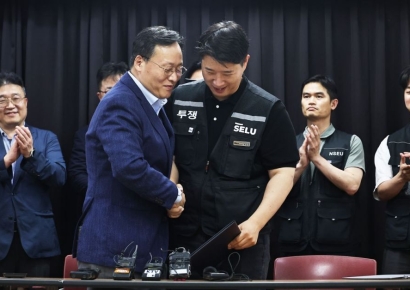 Up to 600 Million Won for Semiconductors, 160 Million Won Bonus for Loss-Making Non-Memory… Samsung Electronics Labor and Management Reach Tentative Deal on Unprecedented Performance Compensation (Comprehensive)
- "Could I Also Receive 370 Billion Won?"... No Limit on 'Stock Manipulation Whistleblower Rewards' Starting the 26th
- "From a 70 Million Won Loss to a 350 Million Won Profit with Samsung and SK hynix"... 'Stock Jackpot' Grandfather Gains Attention
- Opening a Bank Account in Korea Is Too Difficult..."It Costs 150,000 Won Just to Open a Child's Account or Check Card" [Foreigner K-Finance Status]②
- "Who Is Visiting Japan These Days?" The Once-Crowded Tourist Spots Empty Out... What's Happening?
© The Asia Business Daily(www.asiae.co.kr). All rights reserved.
!["Please Help": How Much Do Those Bowing 90 Degrees Really Earn? [Data Pick]](https://cwcontent.asiae.co.kr/asiaresize/307/2026052010120870131_1779239528.png)