Gwangju Urban Railway Line 2 Construction Drives Regional Economic Revitalization
Employment of 4,342 Local Workers... Over 90% Local Workforce Hiring and Equipment Usage

[Asia Economy Honam Reporting Headquarters Reporter Park Seon-gang] The construction project of Gwangju Urban Railway Line 2 is helping to revitalize the local economy, which has been stagnated due to COVID-19, through local workforce employment, equipment usage, and rapid budget execution.
The Gwangju Metropolitan City Urban Railway Construction Headquarters announced on the 23rd that the Urban Railway Line 2, which began construction in September last year, is being promoted in three phases step by step.
Among them, the Phase 1 project covers an approximately 17 km section extending from City Hall through World Cup Stadium and Baegun Square to Gwangju Station, with 20 mainline stations and one vehicle depot, and a project cost of 568.5 billion KRW will be invested by 2023.
The Urban Railway Line 2 construction project has signed construction contracts worth 67.3 billion KRW this year alone amid concerns about the local economy's stagnation due to the spread of COVID-19, and is helping to revitalize the local construction industry through rapid execution and a high participation rate of local companies.
In particular, an additional budget of 28 billion KRW is planned to be executed in the first half of the year.
Along with this, materials and equipment produced locally are used in the construction, and local personnel are given priority employment, contributing to economic revitalization.
Since the start of construction until now, the total number of employed personnel is 4,497 person-times, of which 4,342 person-times are local personnel, and the usage of local equipment amounts to about 1,350 cases, with the employment and equipment usage rates exceeding 90%.
The Urban Railway Construction Headquarters signed a Memorandum of Understanding (MOU) in December last year with six construction companies for Phase 1 of Gwangju Urban Railway Line 2 and local Gwangju companies to expand local construction company participation. They agreed to mutually cooperate on increasing the subcontracting ratio of local construction companies, activating the use of local materials and equipment, and prioritizing local employment, so the participation of local companies and workforce is expected to increase in the future.
The Korea Development Institute predicted in the preliminary feasibility study report for Gwangju Urban Railway Line 2 that the construction project would generate 2.6 trillion KRW in production and added value effects in the Gwangju area, 18,191 jobs induced, and 19,227 employment effects.
Hot Picks Today
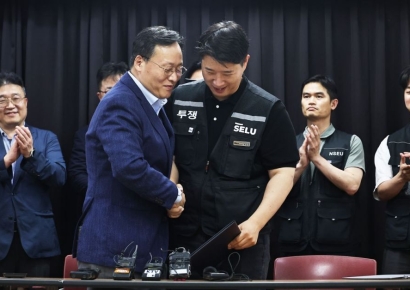 Up to 600 Million Won for Semiconductors, 160 Million Won Bonus for Loss-Making Non-Memory… Samsung Electronics Labor and Management Reach Tentative Deal on Unprecedented Performance Compensation (Comprehensive)
- "Could I Also Receive 370 Billion Won?"... No Limit on 'Stock Manipulation Whistleblower Rewards' Starting the 26th
- "From a 70 Million Won Loss to a 350 Million Won Profit with Samsung and SK hynix"... 'Stock Jackpot' Grandfather Gains Attention
- [Click eStock] "Hyundai Motor's New Business Value Reassessed... Target Price Raised to 770,000 Won"
- "Who Is Visiting Japan These Days?" The Once-Crowded Tourist Spots Empty Out... What's Happening?
Ahn Deok-heon, Head of Management at Gwangju Urban Railway Construction Headquarters, said, “As the construction of Urban Railway Line 2 is progressing smoothly despite the impact of COVID-19, the stagnant local construction industry is being revitalized, and it is expected to further energize the local economy. We plan to continue expanding local company participation and increase the use of locally produced materials and equipment.”
© The Asia Business Daily(www.asiae.co.kr). All rights reserved.







