Opening NSC... Breathless Response to Security and Economy
Blue House to Hold Standing Committee Meeting This Afternoon... Seong Yun-mo, Minister of Industry, Instructed to Attend
Concerns Over Oil Supply if Hormuz Blockade Occurs... Real Economy Adversely Affected by Oil Price Fluctuations

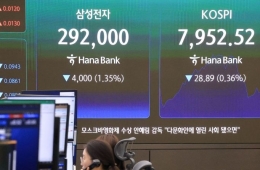
On the 6th, KOSPI opened at 2154.97, down 21.49 points (0.99%) from the previous trading day due to increased volatility in the global financial markets caused by tensions in the US and the Middle East. Dealers are working in the dealing room of KEB Hana Bank in Jung-gu, Seoul. Photo by Jinhyung Kang aymsdream@
View original image[Asia Economy reporters Kwangho Lee and Chulyoung Lim] As the possibility of a clash between the United States and Iran increases, an emergency has been triggered in South Korea's crude oil supply and demand. If global trade contracts due to instability in the Middle East, the export-dependent South Korean economy is also expected to suffer damage. With Iran effectively withdrawing from the nuclear agreement, a significant variable has emerged in the security situation on the Korean Peninsula. The government is holding consecutive emergency meetings and closely monitoring the situation's development.
The Blue House announced that on the afternoon of the 6th, it will hold a Standing Committee meeting of the National Security Council (NSC) chaired by National Security Office Director Chung Eui-yong regarding the escalating conflict between the U.S. and Iran. Regarding this, President Moon Jae-in instructed, "Closely examine not only the security situation but also the safety of Korean residents abroad and crude oil supply and demand," and ordered Minister of Trade, Industry and Energy Sung Yun-mo to attend the NSC Standing Committee meeting in addition to the existing members, according to Blue House spokesperson Ko Min-jung. Minister Sung was originally scheduled to depart that evening to attend the Consumer Electronics Show (CES) held in the U.S.
Separately, the Ministry of Trade, Industry and Energy plans to hold a "Petroleum and Gas Supply and Price Trend Inspection Meeting" at 2 p.m., chaired by Energy Resources Office Director Joo Young-joon. A ministry official said, "Although the uncertainty in the usual environment is high, we are continuously checking the situation," and added, "We will do our utmost to diversify and secure competitiveness to actively respond to changes and shocks in external conditions." The Ministry of Foreign Affairs has also been operating a task force led by First Vice Foreign Minister Cho Se-young since the 5th to prepare for the Middle East situation.
First, the South Korean government authorities are most concerned about the impact on crude oil supply and demand. If Iran blocks the Strait of Hormuz, through which 70% of domestic imported crude oil passes, energy supply and imports could be disrupted. If crude oil prices surge, exports, which have been declining for 13 consecutive months, will find it difficult to escape the slump. On the 3rd (local time), international oil prices fluctuated sharply. Brent crude rose 3.6% compared to the previous day, and West Texas Intermediate (WTI) increased by 3.1%. WTI reached its highest level in about eight months since May last year.
Professor Choi Won-mok of Ewha Womans University Law School expressed concern, saying, "For countries like South Korea that import crude oil, increased volatility in oil prices inevitably raises uncertainty," and "The adverse effects on the real economy are not insignificant." He added, "The Middle East region is important in policies to reduce dependence on China and Japan and serves as a foothold for advancing into Europe," advising, "It is desirable to participate in military actions with the U.S. while clearly aiming to secure peaceful crude oil transportation routes."
However, some in the market assess that the possibility of a blockade is not high and would be limited. Samsung Securities researcher Shim Hye-jin diagnosed, "Since the March 2003 U.S. 'Operation Iraqi Freedom,' this is the highest level of tension, so international oil prices will likely maintain the current level for the time being due to heightened geopolitical risks."
Hot Picks Today
 If They Fail Next Year, Bonus Drops to 97 Million Won... A Closer Look at Samsung Electronics DS Division’s 600M vs 460M vs 160M Performance Bonuses
- Opening a Bank Account in Korea Is Too Difficult..."Over 150,000 Won in Notarization Fees Just for a Child's Account and Debit Card" [Foreigner K-Finance Status]②
- Hundreds of Billions Stolen with Twin USIMs... 32 Members of Chinese Hacking Group Apprehended
- Room Prices Soar from 60,000 to 760,000 Won and Sudden Cancellations: "We Won't Even Buy Water in Busan" — BTS Fans Outraged
- "Who Is Visiting Japan These Days?" The Once-Crowded Tourist Spots Empty Out... What's Happening?
Shinhan Financial Investment researcher Han Yoon-ji also evaluated that the possibility of abnormalities in global crude oil supply and demand due to the escalating confrontation between the U.S. and Iran is limited. He observed, "Iran currently accounts for only 2% of global crude oil production, and the possibility of Iran blocking the Strait of Hormuz is minimal."
© The Asia Business Daily(www.asiae.co.kr). All rights reserved.
!["Please Help Us": How Much Do Those Bowing 90 Degrees These Days Actually Earn? [Data Pick]](https://cwcontent.asiae.co.kr/asiaresize/307/2026052010120870131_1779239528.png)