Buddhist Community Proposes Mount Geumgang Tours and Joint Ceremony; Chung Dongyoung Requests Support
by Son Seonhee
Published 04 Aug.2025 11:46(KST)
On August 4, Minister of Unification Chung Dongyoung met with Buddhist leaders to discuss ways to promote inter-Korean exchanges at the religious level.
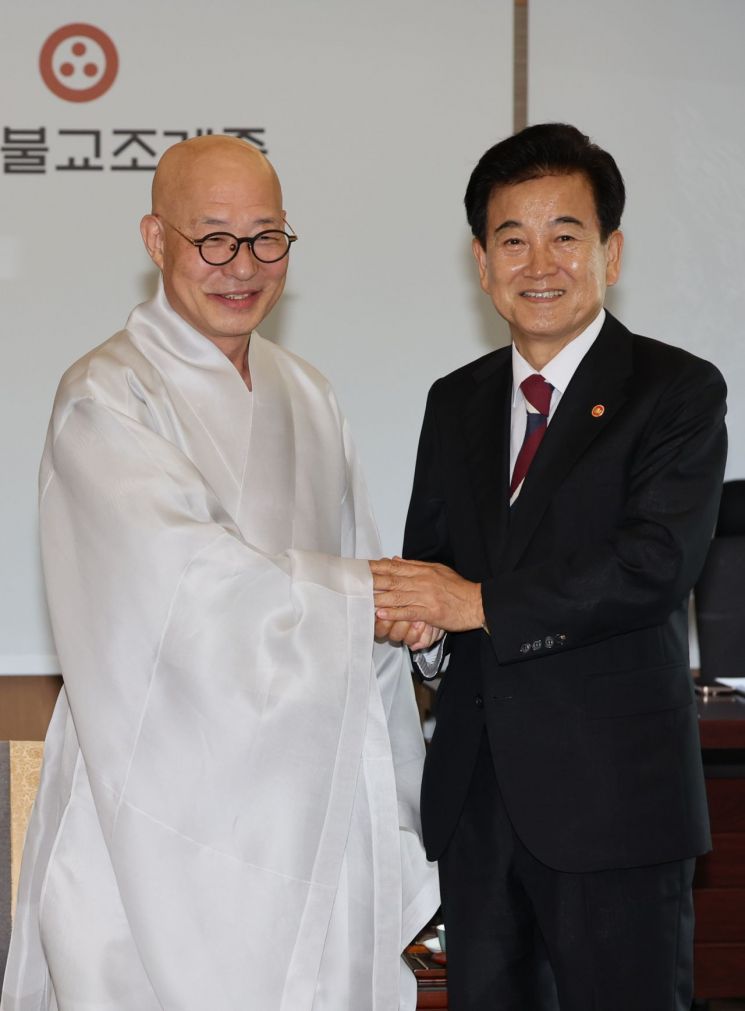
On the morning of the same day, Minister Chung visited Jogyesa Temple in Jongno-gu, Seoul, to meet with Venerable Jinwoo, the head of the Jogye Order of Korean Buddhism. During the meeting, Venerable Jinwoo referred to Mount Geumgang, known as "Ilmanicheonbong Palmanguamja" (meaning "12,000 peaks and 80,000 hermitages"), and stated, "Now that Mount Geumgang has been listed as a UNESCO World Heritage Site, if we approach it in connection with the temples, the North would not object. If North Korea allows the Wonsan-Kalma area to be linked with Mount Geumgang as a tourism product, Buddhist communities could take the lead in visiting, and perhaps next year we could organize a joint Buddhist ceremony centered on Jogyesa Temple." He added, "If the Ministry of Unification communicates closely with us, and if the North finds it difficult to speak directly with the government, they can do so through us."
In response, Minister Chung said, "I would be grateful if the Buddhist community could offer its support."
Venerable Jinwoo also commented, "Not long ago, Kim Yojong, Deputy Director of the North Korean Workers' Party, remarked that 'the South Korean government is showing sincerity,' which suggests that inter-Korean relations are not completely blocked." Minister Chung agreed, saying, "If we act with goodwill, the North will respond in kind. During my confirmation hearing, I also quoted the Buddhist teaching of Wonhyo, 'Bulilbuli' (meaning 'not one, not two'). I believe Buddhism's teachings can guide the two Koreas toward peaceful coexistence."
After his meeting with Venerable Jinwoo, Minister Chung spoke to reporters, saying, "The Venerable always emphasizes the spirit of 'Jaririta' (meaning 'benefiting oneself and others'). It is a philosophy of recognizing, respecting, and coexisting with the other, which fits perfectly with the current situation on the Korean Peninsula." He continued, "The key between the two Koreas is trust. Even now, if North Korea changes its course and seeks a path for mutual survival, that would embody the spirit of Jaririta."

Minister of Unification Chung Dongyoung is visiting Jinwoo, the head monk of Jogye Order, at Jogyesa Temple in Jongno-gu, Seoul on the 4th and taking a commemorative photo. 2025.8.4. Photo by Yonhap News
원본보기 아이콘On the morning of the same day, Minister Chung visited Jogyesa Temple in Jongno-gu, Seoul, to meet with Venerable Jinwoo, the head of the Jogye Order of Korean Buddhism. During the meeting, Venerable Jinwoo referred to Mount Geumgang, known as "Ilmanicheonbong Palmanguamja" (meaning "12,000 peaks and 80,000 hermitages"), and stated, "Now that Mount Geumgang has been listed as a UNESCO World Heritage Site, if we approach it in connection with the temples, the North would not object. If North Korea allows the Wonsan-Kalma area to be linked with Mount Geumgang as a tourism product, Buddhist communities could take the lead in visiting, and perhaps next year we could organize a joint Buddhist ceremony centered on Jogyesa Temple." He added, "If the Ministry of Unification communicates closely with us, and if the North finds it difficult to speak directly with the government, they can do so through us."
In response, Minister Chung said, "I would be grateful if the Buddhist community could offer its support."
Venerable Jinwoo also commented, "Not long ago, Kim Yojong, Deputy Director of the North Korean Workers' Party, remarked that 'the South Korean government is showing sincerity,' which suggests that inter-Korean relations are not completely blocked." Minister Chung agreed, saying, "If we act with goodwill, the North will respond in kind. During my confirmation hearing, I also quoted the Buddhist teaching of Wonhyo, 'Bulilbuli' (meaning 'not one, not two'). I believe Buddhism's teachings can guide the two Koreas toward peaceful coexistence."
After his meeting with Venerable Jinwoo, Minister Chung spoke to reporters, saying, "The Venerable always emphasizes the spirit of 'Jaririta' (meaning 'benefiting oneself and others'). It is a philosophy of recognizing, respecting, and coexisting with the other, which fits perfectly with the current situation on the Korean Peninsula." He continued, "The key between the two Koreas is trust. Even now, if North Korea changes its course and seeks a path for mutual survival, that would embody the spirit of Jaririta."
© The Asia Business Daily(www.asiae.co.kr). All rights reserved.